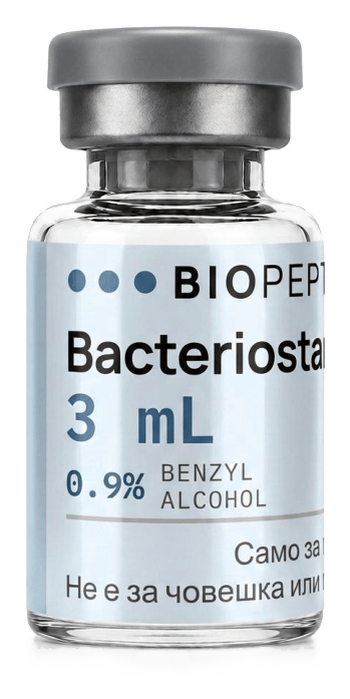
Bac Water
Bacteriostatic Water
Sterile diluent for reconstituting lyophilised peptides.
0.9% Benzyl AlcoholLaboratory diluentSize: 3 mL
Free delivery on orders over €70
Published
Important: This article is intended solely for educational and informational purposes. It does not constitute medical advice and does not encourage the injection, ingestion or any use of peptides in humans or animals. The products on this site are intended for scientific research and laboratory purposes only.
A peptide's activity depends on an intact amino acid chain folded into a particular shape. Degradation is anything that breaks the chain or unfolds it, and the conditions that cause it are well understood. They change substantially the moment water is added.
Lyophilized peptide is comparatively robust. With water removed, the chemical reactions that break peptide bonds have no medium to occur in. A sealed vial kept cold and dark is stable for a long period — typically years at -20°C, and months at refrigerator temperature.
The main threat at this stage is moisture. Cold glass brought into warm air collects condensation, and if that happens with the stopper off, water enters the vial. This is why a vial should always be brought to room temperature before it is opened.
In solution the picture reverses. Hydrolysis, oxidation and aggregation all become possible, and stability drops from years to weeks. A reconstituted vial belongs in a refrigerator at 2–8°C, used within the window documented for that compound.
Freezing a reconstituted vial is a common and damaging mistake. Ice crystals forming and melting concentrate the solute and create interfaces where peptide chains aggregate. One freeze-thaw cycle can cost more activity than weeks of correct refrigeration.
Lyophilized peptide should look like a white powder or a compact film. A yellowed or sticky appearance suggests moisture has reached it. In solution, the expectation is clear and colourless — with the notable exception of GHK-Cu, whose copper complex is legitimately blue. Cloudiness, visible particles or floating strands in any other compound indicate the vial should be discarded.
Everything here concerns keeping research material intact in a laboratory. None of it is advice about use in humans or animals, and the products are not sold for that.