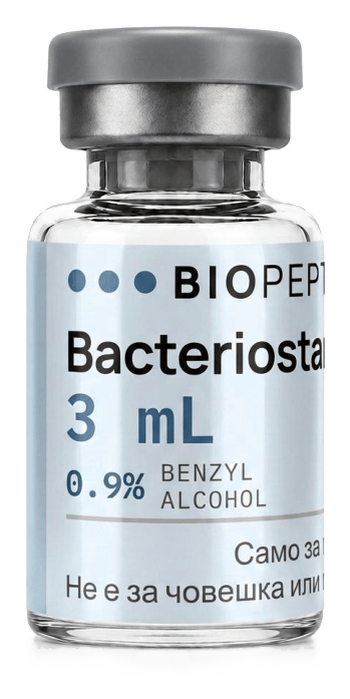
Bac Water
Bacteriostatic Water
Sterile diluent for reconstituting lyophilised peptides.
0.9% Benzyl AlcoholLaboratory diluentSize: 3 mL
Free delivery on orders over €70
Published
Important: This article is intended solely for educational and informational purposes. It does not constitute medical advice and does not encourage the injection, ingestion or any use of peptides in humans or animals. The products on this site are intended for scientific research and laboratory purposes only.
Research peptides are supplied lyophilized — freeze-dried into a white powder or a thin film at the bottom of the vial. Water is what lets peptides degrade, so removing it is what makes a compound stable enough to ship and store. Reconstitution is the step where that water goes back in, and it is where most avoidable losses happen.
Sterile water contains no preservative. Once a vial is opened, anything introduced into it can grow. Bacteriostatic water is the same water with 0.9% benzyl alcohol added, which inhibits bacterial growth rather than killing what is already present. The practical consequence is shelf life after opening: a vial reconstituted with bacteriostatic water can be sampled repeatedly within the documented storage period under refrigeration, whereas sterile water suits single-session work.
A small number of peptides are incompatible with benzyl alcohol and are documented as requiring plain sterile water. Check the compound before assuming.
Shaking is the most common way a vial is ruined. Peptides are chains folded into a specific shape, and their activity depends on that shape. Vigorous agitation creates shear forces and an air-liquid interface where the chains unfold and stick to one another. The visible result is foaming; the invisible result is aggregated peptide that no longer does what it was characterised to do. Swirl, do not shake.
Concentration is simply the amount of peptide divided by the volume of water added. A 5 mg vial reconstituted with 2 mL of bacteriostatic water gives 2.5 mg/mL. The same vial with 1 mL gives 5 mg/mL. The quantity of peptide never changes — only how dilute it is.
A reconstituted vial belongs in a refrigerator, not a freezer — freeze-thaw cycles damage peptides in solution. Keep it away from light, and return it to cold storage promptly rather than leaving it out between experiments.
For laboratory and research use only. This article describes handling procedure for research materials and is not medical guidance of any kind.