Melanocortin Receptor Research
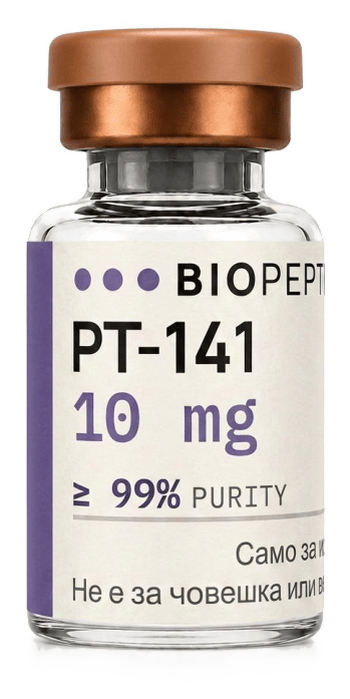
PT-141
Melanocortin receptor agonist studied in CNS pathway research.
≥99% (HPLC)Size: 10 mg
Free delivery on orders over €70
Published
Important: This article is intended solely for educational and informational purposes. It does not constitute medical advice and does not encourage the injection, ingestion or any use of peptides in humans or animals. The products on this site are intended for scientific research and laboratory purposes only.
PT-141, also known as bremelanotide, is a synthetic peptide analogue of α-melanocyte-stimulating hormone (α-MSH) acting on the melanocortin receptor system. Unlike erectile dysfunction medicines that work mainly on blood flow, PT-141 is interesting for its action on the central nervous system and the melanocortin receptors tied to sexual desire and sexual behaviour. Bremelanotide has been studied both in men with erectile dysfunction and in women with reduced sexual desire; the strongest clinical base to date is in premenopausal women with acquired, generalised hypoactive sexual desire disorder (HSDD).
PT-141 is a synthetic analogue of α-MSH belonging to the melanocortin receptor agonists. Studies show bremelanotide has affinity for several melanocortin receptors, with MC3R and MC4R mattering most for its sexual effects. These receptors are expressed in various regions of the central nervous system, including structures involved in regulating sexual behaviour. This makes its mechanism different from PDE5 inhibitors such as sildenafil, which act mainly through the NO–cGMP pathway and increased blood flow.
The melanocortin system participates in a range of physiological processes: appetite and energy balance, pigmentation, stress responses, sexual behaviour and sexual motivation. PT-141 activates melanocortin receptors in the central nervous system and can thereby influence the neural mechanisms tied to sexual desire and arousal. Preclinical work showed that activating this system can elicit sexual responses in animal models; in humans, subsequent clinical studies demonstrated physiological and subjective effects on sexual function.
A defining feature of bremelanotide is that its potential effect is not limited to the physiological component of sexual function. Sexual desire involves complex interactions between brain structures, neurotransmitters, hormonal factors, psychological factors and sexual stimuli — and the melanocortin system is part of that network. This is one reason PT-141 has been studied in hypoactive sexual desire disorder (HSDD), a condition of persistently reduced sexual desire causing significant personal or interpersonal distress.
Early clinical research pointed to a potential effect on erectile function. A randomised, double-blind 2004 study examined healthy men and men with mild-to-moderate erectile dysfunction. After intranasal administration of PT-141, a dose-dependent erectile response was observed. At doses above 7 mg the effect was statistically distinguishable from placebo, with the first erection occurring roughly 30 minutes after administration and a mean elimination half-life of about 1.85–2.09 hours. The most commonly reported adverse reactions were flushing and nausea.
In a randomised study of 342 men with erectile dysfunction unresponsive to sildenafil, bremelanotide produced a higher rate of positive clinical outcomes than placebo — 33.5% versus 8.5%. The authors stressed the need for further work to optimise dosing and administration. Interesting results, but they do not make PT-141 a universal solution for erectile dysfunction.
Bremelanotide's most significant clinical programme concerns HSDD in premenopausal women. Two large Phase 3 trials, known as RECONNECT, enrolled 1,267 women randomised to bremelanotide or placebo for 24 weeks. The results showed statistically significant increases in sexual desire and reductions in the distress associated with low desire. In the integrated analysis, the desire score improved by roughly 0.35 points more than placebo, while desire-related distress fell by roughly 0.33 points more than placebo. This is one of the most substantial clinical bases for a melanocortin agonist in female sexual dysfunction.
After the core 24-week phase, a subset of participants continued into a 52-week open-label extension. Of 856 eligible women, 684 chose to participate and 272 completed the full period. No new significant safety signals were identified. The most common treatment-related adverse reactions were nausea (40.4%), flushing (20.6%) and headache (12.0%). The authors reported that improvements in desire and related distress were maintained.
Hypoactive Sexual Desire Disorder does not simply mean “low libido”. The medical concept involves persistently reduced or absent sexual desire causing significant personal distress or relationship problems. Sexual desire can be influenced by psychological factors, stress, relationships, medications, hormonal changes, other conditions and neurotransmitter mechanisms. Bremelanotide's action should therefore not be read as simply “switching on” libido.
PDE5 inhibitors such as sildenafil and tadalafil mainly amplify the NO → cGMP → smooth muscle relaxation → increased blood flow pathway — that is, the physiological mechanism of erection. With bremelanotide the interest lies in the chain melanocortin receptors → central nervous system → sexual motivation, arousal and physiological sexual response. This is why melanocortin agonists represent a distinct pharmacological strategy in sexual dysfunction.
Clinical studies show bremelanotide has comparatively well-characterised adverse reactions — most often nausea, flushing and headache, all significantly more frequent than placebo in the Phase 3 trials. This is an important part of the molecule's profile, and a reminder that a “stronger effect” should not automatically be read as a “better effect”.
Unlike many experimental peptides, bremelanotide has a substantially larger base of human clinical data — the Phase 3 programme enrolled over 1,200 women, and the 52-week extension adds information on prolonged exposure. Even so, the results belong to a specific approved formulation, population and indication. Data on medical bremelanotide does not automatically mean every product sold as “PT-141” shares the same purity, stability, pharmacokinetics or safety profile.
First, the strongest modern data concerns one indication — HSDD in a defined group of women. Second, the results in men are more limited and historically used different routes of administration. Third, sexual desire is hard to measure objectively; trial endpoints rely on validated questionnaires and self-report. Notably, a later analysis questioned the validity of some of the endpoints used and judged the overall effect size to be modest — worth bearing in mind when interpreting the Phase 3 results.
PT-141, or bremelanotide, is an interesting example of a peptide that moved from experimental molecule to clinically developed melanocortin agonist. Unlike many peptides, it has randomised human trials, including a large Phase 3 programme in women with HSDD. In men, early studies showed potential for stimulating erection, including in some patients unresponsive to sildenafil, though that data is more limited. Its key scientific distinction is the mechanism — rather than mainly increasing local blood flow, it engages the melanocortin system tied to central regulation of sexual behaviour. At the same time, the clinical effects are not large, and the adverse reactions are well documented. PT-141 should be seen not as a “super-libido peptide” but as a molecule with a genuinely studied, yet specific, pharmacological effect on sexual function.