Melanocortin Receptor Research
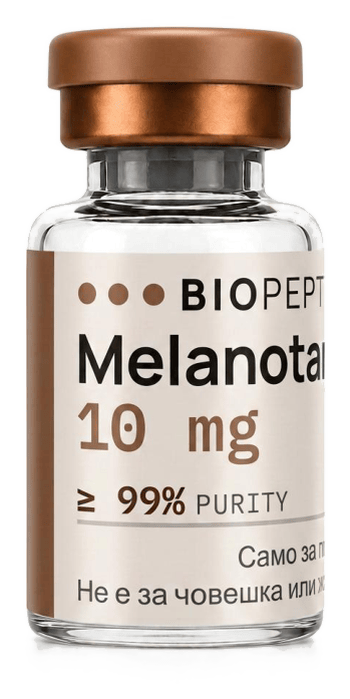
Melanotan I
Melanocortin agonist studied in pigmentation pathway research.
≥99% (HPLC)Size: 10 mg
Free delivery on orders over €70
Published
Important: This article is intended solely for educational and informational purposes. It does not constitute medical advice and does not encourage the injection, ingestion or any use of peptides in humans or animals. The products on this site are intended for scientific research and laboratory purposes only.
Melanotan I is a synthetic analogue of natural α-melanocyte-stimulating hormone (α-MSH) — a peptide central to regulating melanogenesis and melanin production. In the medical literature, the most important variant of Melanotan I is afamelanotide (NDP-α-MSH), a modified α-MSH analogue built for longer action and more stable pharmacological activity. Unlike Melanotan II, afamelanotide has real clinical development behind it, a substantial trial programme, and an approved medical use: in the EU, Scenesse (afamelanotide) is authorised for adults with erythropoietic protoporphyria (EPP) — a rare disease in which light exposure can trigger severe, painful reactions.
The core mechanism runs through the melanocortin receptor MC1R. Stimulating MC1R in melanocytes activates processes that increase production of eumelanin — the brown-black pigment that darkens skin. Simplified: Melanotan I → MC1R → increased melanogenesis → more eumelanin → deeper pigmentation. Eumelanin also has a natural photoprotective function, absorbing part of UV radiation — the very mechanism behind afamelanotide's medical use in EPP.
Melanotan I stimulates the melanocytes themselves — different from cosmetic self-tanners, which colour the surface skin layers through a chemical reaction. The result is increased melanin synthesis and a change in the skin's natural pigmentation response. In afamelanotide this mechanism is used clinically to raise photoprotective eumelanin in EPP patients.
Both molecules relate to α-MSH and the melanocortin system, but they are not the same molecule. Melanotan II was developed as a more potent experimental melanocortin agonist with broader receptor activity. Melanotan I/afamelanotide was developed with a much sharper focus on MC1R and melanogenesis. If the scientific interest is pigmentation, Melanotan I has the more predictable and better-studied pharmacological profile.
Potency and overall pharmacological profile are different things — Melanotan II is often described as “stronger”, but stronger is not automatically better. First, the clinical record: afamelanotide's greatest advantage is the volume of clinical data — multiple trials in EPP patients, including Phase II and III studies, and regulatory approval; Melanotan II has no comparable validation. Second, MC1R specificity: Melanotan II's broader profile brings effects beyond the skin. Third, better-characterised duration: in the medical product Scenesse the active substance releases gradually from an implant, allowing sustained stimulation rather than short peaks.
Eumelanin absorbs part of UV and visible light and can reduce its penetration into skin — especially significant in EPP. In a clinical study of 93 patients, EMA reports that patients on Scenesse could spend an average of 116 hours in direct sunlight without pain over six months, versus 61 hours on placebo. Melanotan I does not merely change skin colour — activated eumelanin has a real biological function. That does not make unlimited UV exposure safe.
The term “Melanotan I” is used online for many products. Scientifically and in regulatory terms, afamelanotide — the characterised active substance of the approved medicine Scenesse — must be distinguished from unregulated products sold under the same name. Clinical data on afamelanotide does not prove the quality, purity or safety of any product carrying a “Melanotan I” label.
In the Scenesse trials, the most commonly reported adverse reactions were nausea, headache, implant-site reactions and pigmentation changes — generally mild to moderate. Approved afamelanotide must be distinguished from unregulated products: with unregulated α-MSH analogues, changes in pigmented lesions and new naevi have been described. A causal link to melanoma has not been definitively proven, but the dermatological literature urges serious attention to these observations.
Even when pigmentation is stimulated through MC1R, UV radiation does not become safe. Increased eumelanin may play a photoprotective role, but it does not replace sunscreen, protective clothing, sensible limits on UV exposure, or dermatological monitoring. Afamelanotide's medical use in EPP is a specific therapeutic situation, not proof that Melanotan I makes prolonged sun exposure risk-free.
Melanotan I — specifically the medical analogue afamelanotide — is far better studied than Melanotan II: better-established clinical efficacy, a much larger human data base, better-characterised pharmacology, demonstrated eumelanin stimulation, and a genuinely approved medical use in EPP. Melanotan II may be more potent as an experimental melanocortin agonist, but that alone does not make it better. On the criteria of scientific validation, clinical data and predictability, Melanotan I/afamelanotide holds a clear advantage — while approved afamelanotide must never be equated automatically with an unregulated product sold online as “Melanotan I”.