Out of Stock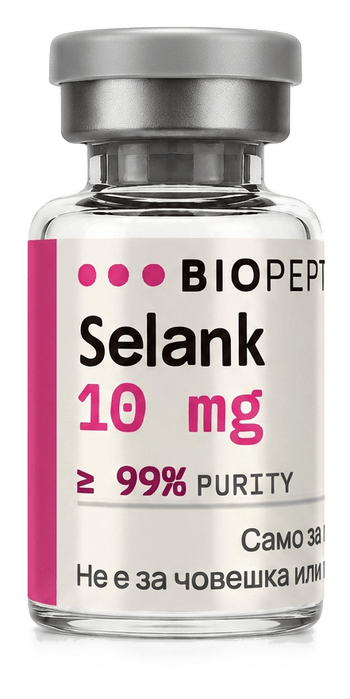
Tissue & Neuropeptide Research
Selank
Synthetic tuftsin-analogue heptapeptide studied in neuropeptide and immunology research.
Out of Stock≥99% (HPLC)Size: 5 mg · 10 mg
Free delivery on orders over €70
Published
Important: This article is intended solely for educational and informational purposes. It does not constitute medical advice and does not encourage the injection, ingestion or any use of peptides in humans or animals. The products on this site are intended for scientific research and laboratory purposes only.
Selank is a synthetic heptapeptide: threonine, lysine, proline, arginine, proline, glycine, proline (TKPRPGP). It was developed at the Institute of Molecular Genetics of the Russian Academy of Sciences, and most of the published work on it comes from Russian laboratories.
The first four residues, Thr-Lys-Pro-Arg, are tuftsin — a short peptide cleaved from the Fc region of immunoglobulin G and studied for its effects on immune cells. On its own, tuftsin is broken down within minutes by peptidases. Selank adds a Pro-Gly-Pro tail to the C-terminus, a modification intended to slow that breakdown. The design question behind the compound is whether a natural regulatory fragment can be made stable enough to study.
The preclinical literature falls into three strands. Rodent behavioural work examines Selank in standard stress and anxiety models. Gene-expression studies look at what changes in brain tissue after administration in animals. And enzyme work asks whether the peptide slows the breakdown of enkephalins, the body's own opioid peptides.
The GABAergic findings are the ones most often repeated. A 2016 study measured the expression of dozens of genes involved in GABA signalling in rodent brain tissue after Selank administration and reported changes in several of them — an association at the level of gene expression, not a demonstrated mechanism of action.
Two cautions apply. Most studies come from a small group of laboratories, so independent replication is limited. And much of the work appears in Russian-language journals, often available only as abstracts in translation, which makes the methods harder to check. Selank is registered as a medicine in Russia; it is not approved in the European Union, and the compound sold here is a research reagent.
Like other short peptides, Selank is supplied lyophilised and is best stored at -20°C until the vial is opened. Once reconstituted, keep it at 2–8°C; the free peptide remains susceptible to peptidases, so solutions should be prepared in clean conditions and not kept longer than the stability data supports.
Sold for laboratory and research use only. Nothing above is guidance for use in humans or animals.