Cellular Pathway Research
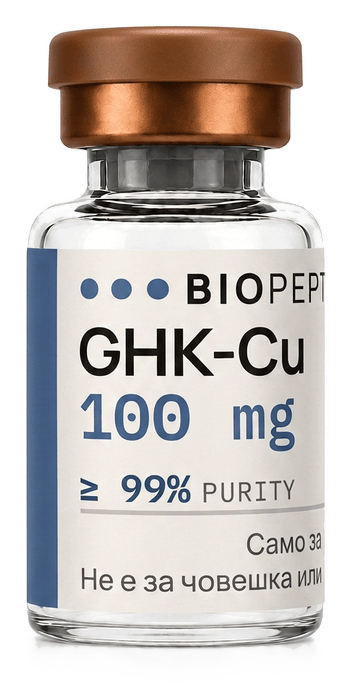
GHK-Cu
Copper-binding tripeptide studied in gene-expression and extracellular-matrix research.
≥99% (HPLC)Size: 100 mg
Free delivery on orders over €70
Published
Important: This article is intended solely for educational and informational purposes. It does not constitute medical advice and does not encourage the injection, ingestion or any use of peptides in humans or animals. The products on this site are intended for scientific research and laboratory purposes only.
GHK-Cu is one of the shortest peptides in common research use: glycine, histidine, lysine, bound to a copper ion. It occurs naturally in human plasma, where it was first characterised.
GHK binds copper(II) with high affinity, and the complex is what the research concerns. Copper is a cofactor for enzymes involved in building connective tissue — lysyl oxidase, which cross-links collagen and elastin, among them. The peptide is studied as a delivery mechanism that presents copper to cells in a controlled form, rather than as a peptide that happens to carry a metal.
This is what separates GHK-Cu from copper salts. The complex, not the element in isolation, is what the literature examines.
The finding that broadened interest beyond dermatology came from gene expression work. Analyses of cell-based datasets reported GHK-Cu shifting the expression of a large number of human genes rather than acting on one pathway. A broad transcriptional effect is unusual for a tripeptide, which is why it appears in gene-expression research beyond dermal models.
The copper complex gives GHK-Cu its distinctive blue colour in solution — a useful visual confirmation that reconstitution has gone as expected. It is light-sensitive, so vials should be kept dark, and it is typically supplied in larger milligram quantities than most peptides, which changes the diluent volume needed for a given concentration.
Sold for laboratory and research use only. The gene-expression findings above are striking and also preliminary — worth reading the source rather than the summary.