Metabolic Pathway Research
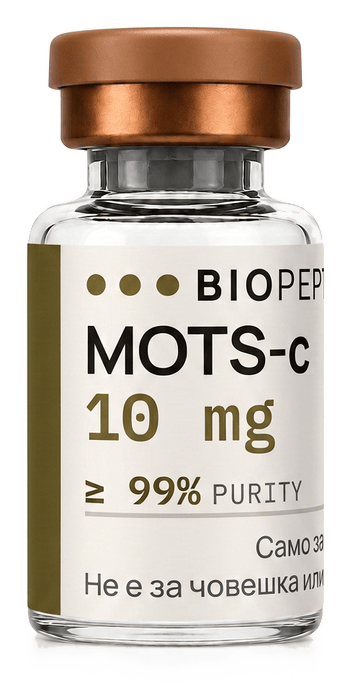
MOTS-c
Mitochondrial-derived peptide studied in cellular metabolism research.
≥99% (HPLC)Size: 10 mg
Free delivery on orders over €70
Published
Important: This article is intended solely for educational and informational purposes. It does not constitute medical advice and does not encourage the injection, ingestion or any use of peptides in humans or animals. The products on this site are intended for scientific research and laboratory purposes only.
Mitochondria carry their own small genome, a remnant of the bacteria they descend from. For most of the history of cell biology that genome was understood to encode components of the respiratory chain and little else. MOTS-c complicated that picture.
MOTS-c — mitochondrial open reading frame of the twelve S rRNA type-c — is a sixteen-amino-acid peptide encoded within the mitochondrial 12S ribosomal RNA gene. It was described by Lee and colleagues in Cell Metabolism in 2015 [1]. The finding of interest was not simply that the peptide existed, but that it appeared to act outside the mitochondrion, on the cell around it and on distant tissue.
That places it in a small category sometimes described as mitochondrial-derived peptides: molecules that suggest the mitochondrial genome participates in signalling rather than only in energy production.
The 2015 work reported that MOTS-c acts principally on skeletal muscle, interfering with the folate cycle and the purine synthesis pathway that depends on it. The consequence of that interference is accumulation of an intermediate that activates AMPK — the enzyme cells use to sense low energy and switch toward generating it rather than storing it.
AMPK is a well-characterised metabolic switch, which is why this route attracted attention: it connects a mitochondrial peptide to a pathway already understood in detail.
In the reported experiments, MOTS-c administration in mice prevented insulin resistance associated both with age and with a high-fat diet, and reduced diet-induced obesity. Subsequent work has examined circulating MOTS-c levels in relation to metabolic state and exercise.
The essential qualifier: this is animal and cell work. Human clinical trials of the kind that exist for tesamorelin or semaglutide have not been conducted for MOTS-c, and no regulator has reviewed it.
Supplied lyophilized and reconstituted with bacteriostatic water. As a short peptide it is straightforward to dissolve; the usual rules apply — bring the vial to room temperature before opening, swirl rather than shake, refrigerate once in solution.
Supplied for laboratory and research use only. Given how early this literature is, treat confident claims about MOTS-c — including elsewhere on the internet — with suspicion.