Tissue & Neuropeptide Research
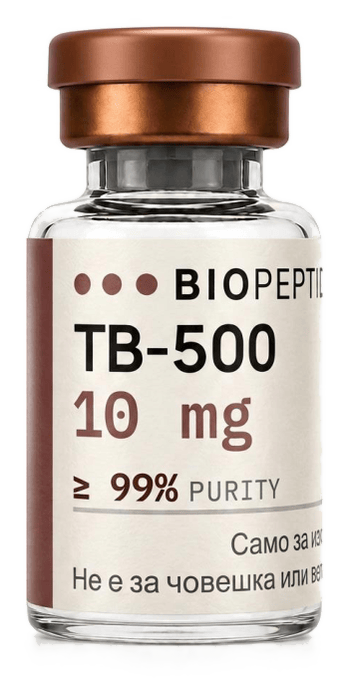
TB-500
Synthetic fragment of thymosin beta-4.
≥99% (HPLC)Size: 10 mg
Free delivery on orders over €70
Published
Important: This article is intended solely for educational and informational purposes. It does not constitute medical advice and does not encourage the injection, ingestion or any use of peptides in humans or animals. The products on this site are intended for scientific research and laboratory purposes only.
TB-500 is a synthetic peptide related to the natural protein thymosin β4 (Tβ4). It attracts interest through its connection to actin biology, cell migration and tissue-repair processes. But one crucial point is often skipped: TB-500 is not identical to full thymosin β4. The scientific literature describes TB-500 as the N-acetylated seven-amino-acid fragment Ac-LKKTETQ, corresponding to positions 17–23 of thymosin β4 — the part involved in actin binding. The distinction matters: results obtained with full thymosin β4 cannot automatically be attributed to TB-500. This material is educational — TB-500 is an investigational molecule, and the available data is not evidence of safety or therapeutic efficacy in humans.
Thymosin β4 is a natural 43-amino-acid peptide found widely in mammalian cells. One of its best-studied functions is binding G-actin — the monomeric form of actin involved in building and remodelling the cytoskeleton. By regulating available G-actin, thymosin β4 can influence processes such as cell migration and cytoskeletal reorganisation — particularly interesting where cells must travel to a site of injury.
It is therefore not scientifically correct to say “TB-500 is thymosin β4”. The accurate statement: “TB-500 is a synthetic fragment related to thymosin β4”.
Actin is one of the cell's core structural components — involved in cell shape, migration, division, intracellular transport and mechanical organisation. Thymosin β4 is among the main molecules regulating the availability of monomeric G-actin, which matters for cytoskeletal dynamics — the process that lets cells change shape and move. Research links Tβ4's actin interaction to a range of biological processes, including cell migration and angiogenesis.
After tissue injury, cells must travel to the affected zone — a complex coordination of cytoskeleton, adhesion, migration, proliferation and tissue remodelling. Preclinical studies show Tβ4 stimulating cell migration, including of keratinocytes and endothelial cells — one reason it is studied as a potential regenerative factor.
Angiogenesis — forming new blood vessels from existing vasculature — is an important part of tissue repair. Thymosin β4 is linked to several processes in vascular development: one literature review describes roles in vasculogenesis, angiogenesis, arteriogenesis and extracellular matrix remodelling, and another examines the mechanisms by which Tβ4 may influence angiogenesis and its potential in tissue repair.
In an early rat study, Tβ4 applied in a skin-wound model produced faster re-epithelialisation, greater wound contraction, increased collagen deposition and enhanced angiogenesis versus controls. A review of the preclinical work describes potential roles for Tβ4 in cell migration, blood vessel formation, cell survival, modulation of inflammation and tissue repair. Scientifically interesting — but preclinical.
Here the TB-500/Tβ4 distinction matters most. Clinical studies exist for thymosin β4, including in wound healing: a Phase 2 trial in venous ulcer patients enrolled 73 participants to assess topical Tβ4, reporting an acceptable safety profile and a signal of potentially faster healing at a particular concentration. But this must not be presented as clinical evidence for TB-500 — the study used thymosin β4. That is an essential difference.
The published analytical data identifies TB-500 as the N-acetylated fragment Ac-LKKTETQ. A 2012 study used HPLC and high-resolution mass spectrometry to identify the fragment and developed a method to detect the molecule and its metabolites in plasma and urine. Another analytical study describes TB-500 as a synthetic version of an active region of thymosin β4 and developed an LC-MS doping-control method. These publications matter mainly for identification and analytical characterisation — not as evidence of therapeutic efficacy in humans.
TB-500 is only a small fragment of the 43-amino-acid molecule. Removing the remaining amino acids can change structure, pharmacokinetics, stability, molecular interactions, biological activity and distribution in the body. So: scientific results for Tβ4 belong to Tβ4; for TB-500, specific data on the fragment itself must be sought. This is one of the most important takeaways in evaluating the literature.
TB-500 is an interesting synthetic peptide fragment tied to the biology of thymosin β4 and the actin cytoskeleton. Scientific interest in the Tβ4 system stems from its role in cell migration, angiogenesis, inflammation and tissue repair, and the preclinical research on the full protein shows a range of interesting results. The most important scientific nuance is that TB-500 and full thymosin β4 are not the same molecule — Tβ4 study results must be presented as Tβ4 data, not automatically as proof of TB-500's efficacy. That distinction is what allows the TB-500 literature to be presented honestly: an interesting experimental peptide with biological grounds for study, and a need for more data on the fragment itself.