Out of Stock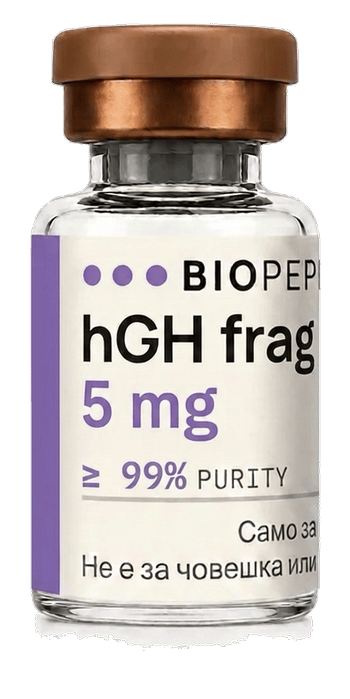
Metabolic Pathway Research
HGH Fragment 176-191
C-terminal fragment of human growth hormone, studied in metabolic research.
Out of Stock≥99% (HPLC)Size: 5 mg
Free delivery on orders over €70
Published
Important: This article is intended solely for educational and informational purposes. It does not constitute medical advice and does not encourage the injection, ingestion or any use of peptides in humans or animals. The products on this site are intended for scientific research and laboratory purposes only.
hGH Frag 176–191 is a synthetic peptide fragment corresponding to the C-terminal portion of human growth hormone (hGH). Interest in it stems mainly from research into the role of that C-terminal region in lipid metabolism. It is essential, however, to distinguish the unmodified hGH Frag 176–191 from the related analogue AOD-9604, because most of the human research was carried out with AOD-9604 rather than the original fragment.
hGH Frag 176–191 is a peptide fragment of the final amino acids of human growth hormone. It represents part of the hGH structure but does not carry the full molecular structure of the hormone itself. Early experimental work on C-terminal hGH fragments showed that certain sequences in this region can display biological activity related to lipid metabolism — which laid the groundwork for studying the region as a subject of metabolic interest.
One of the main areas of study is how the fragment interacts with the processes regulating adipose tissue metabolism. In experimental models, C-terminal hGH fragments have shown anti-lipogenic activity — suppression of the processes involved in forming and accumulating lipids in adipose tissue. These findings are interesting because the full growth hormone has a considerably broader biological action. Crucially, the presence of a mechanism in a laboratory or animal model does not demonstrate that the same effect occurs in the same way in humans.
In a 1978 study, fragment 176–191 was examined in rats alongside several other C-terminal fragments. A short-lived rise in blood glucose and a longer rise in plasma insulin were observed, and with certain fragments a reduction in insulin sensitivity was recorded. A separate 1993 study found anti-lipogenic activity of the synthetic 177–191 sequence in experimental models, with the authors proposing that a functional region tied to hGH's lipid metabolism sits in the C-terminal part of the molecule. Scientifically interesting — but preclinical, and not evidence of efficacy in humans on its own.
This is the most important distinction. AOD-9604 was developed as a modified peptide based on the C-terminal region of hGH, to study that fragment's metabolic properties. AOD-9604 has been studied in humans, including clinical trials in overweight and obesity. In a large Phase 2B trial, however, no statistically significant difference from placebo was achieved on the primary weight-reduction endpoint, and development for obesity was discontinued. Results from the AOD-9604 trials therefore must not be presented as clinical evidence for the unmodified hGH Frag 176–191.
Unlike AOD-9604, the scientific data on the unmodified hGH Frag 176–191 in humans is very limited. There is not enough quality clinical data to demonstrate efficacy for reducing body fat or body weight in humans. Claims such as “a proven fat burner” or “a clinically proven weight-loss peptide” are not supported by the available data on the unmodified fragment.
A central problem in assessing hGH Frag 176–191 is the absence of adequate clinical data on long-term safety. Early animal experiments indicate that some C-terminal hGH fragments can affect glucose and insulin metabolism. That does not mean the same effects necessarily appear in humans, but it shows why safety must not be assumed from a proposed mechanism alone. Products sold as research peptides can also vary in purity, identity and concentration depending on the manufacturer and the analytical control applied.
hGH Frag 176–191 is a C-terminal fragment of human growth hormone of interest to research on lipid and metabolic exchange. Preclinical studies show biological activity of C-terminal hGH fragments, including anti-lipogenic effects in experimental models. At the same time, the available data does not allow the unmodified fragment to be described as a clinically proven weight-loss agent, and the AOD-9604 findings must not be transferred to it. For now it remains a molecule of scientific interest requiring further research.