GH-Axis Research
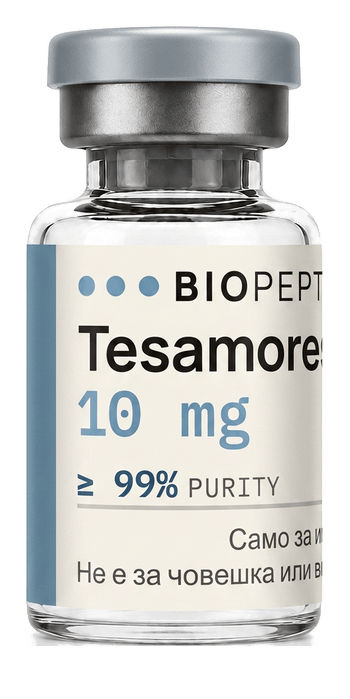
Tesamorelin
GHRH analogue studied in growth-hormone axis research.
≥99% (HPLC)Size: 10 mg
Free delivery on orders over €70
Published
Important: This article is intended solely for educational and informational purposes. It does not constitute medical advice and does not encourage the injection, ingestion or any use of peptides in humans or animals. The products on this site are intended for scientific research and laboratory purposes only.
Tesamorelin is a synthetic analogue of growth hormone-releasing hormone (GHRH) — the hormone that naturally prompts the pituitary to release growth hormone (GH). Unlike direct GH administration, tesamorelin acts upstream on the physiological axis: tesamorelin → GHRH receptor → higher GH → higher IGF-1. This mechanism is interesting for adipose tissue metabolism, especially visceral adipose tissue (VAT). Tesamorelin also has a clinically approved pharmaceutical form: in the US, EGRIFTA WR is approved to reduce excess abdominal fat in adults with HIV-associated lipodystrophy. The official information states explicitly that it is not indicated for treating obesity or general weight management.
Tesamorelin mimics GHRH. Activating the GHRH receptor in the pituitary stimulates GH secretion, and GH in turn has various metabolic effects, including on lipolysis and the distribution of adipose tissue. Simplified: tesamorelin → GHRH-R → higher GH → higher IGF-1 plus changes in lipid metabolism. That is a different mechanism from GLP-1 agonists such as semaglutide — where semaglutide mainly affects appetite, food intake and glucose metabolism, tesamorelin targets GH/GHRH physiology and fat distribution.
The strongest clinical data for tesamorelin concerns visceral fat. A large randomised placebo-controlled trial enrolled 404 HIV-positive patients with central fat accumulation. After 6 months, visceral adipose tissue fell by roughly 10.9% on tesamorelin versus about 0.6% on placebo, with improvements in waist circumference and some body-composition measures. In patients continuing to 12 months, VAT reduction reached roughly 18%. Notably, on stopping and switching to placebo, much of the reduction reversed relatively quickly — suggesting the effect depends on continued pharmacological stimulation rather than representing a lasting change after a short course.
Visceral adipose tissue surrounds the internal organs in the abdominal cavity and differs from subcutaneous fat, which sits directly under the skin. The distinction matters: subcutaneous and visceral fat are not the same thing. Tesamorelin shows a more pronounced effect on visceral than subcutaneous fat — that selectivity is one of the molecule's most interesting characteristics.
In a randomised clinical trial of 50 HIV-positive patients with abdominal fat accumulation, tesamorelin reduced both visceral fat and liver fat. Over 6 months, VAT fell significantly versus placebo, liver fat fell too, and the net effect on the liver-fat measure was roughly −2.9 percentage points. The authors stress that further research is needed to establish the clinical significance and long-term effect of these changes.
Here lies one of the most essential distinctions: tesamorelin is not a typical general weight-loss medicine. Although it can reduce visceral fat, total body weight may not change much — the molecule's aim is a change in fat distribution rather than maximum weight reduction. The official EGRIFTA WR information likewise notes a weight-neutral effect and no indication for weight management.
An expected pharmacological effect is elevated IGF-1 (insulin-like growth factor 1) downstream of GH stimulation. In the clinical trials, IGF-1 elevation was observed alongside the visceral fat reduction. That matters for interpretation: tesamorelin should not be viewed as a mere “fat burner” — it changes the activity of the whole GH/IGF-1 axis.
The glucose effects are more complex. Some studies found no significant long-term changes in the main glucose-metabolism measures, although blood glucose can change in some patients. In one trial, a transient early rise in fasting glucose was observed, but by 6 months the difference from placebo was not statistically significant. It is therefore not correct to present tesamorelin as an insulin-sensitivity aid without further context.
Because it acts on the GH/IGF-1 system, tesamorelin has real pharmacological effects and potential adverse reactions: injection-site reactions, joint pain, peripheral oedema, muscle pain, headache, elevated IGF-1 and glucose-metabolism changes. Clinical studies have also observed hypersensitivity reactions and formation of antibodies against tesamorelin. The official information stresses that long-term cardiovascular safety has not been established.
Yes. Tesamorelin differs from many peptides sold online purely as “research peptides”. In the US, EGRIFTA WR is approved for a specific indication — reducing excess abdominal fat in adults with HIV-associated lipodystrophy. In Europe the situation differs: the European Medicines Agency records that the Egrifta application was withdrawn in 2012, and the product has no EU marketing authorisation. An approved form in one jurisdiction does not automatically make every form of tesamorelin an approved medicine in Bulgaria or the EU.
Tesamorelin is a synthetic GHRH analogue that stimulates the natural GH/IGF-1 axis and stands apart from many peptides in having substantial clinical data. Its best-supported effect is the chain GHRH receptor → higher GH/IGF-1 → reduced visceral fat, with some studies also showing reduced liver fat. At the same time, tesamorelin should not be presented as a weight-loss product — its effect is specific to visceral fat, and total body weight may remain relatively unchanged. Its official US indication is limited to HIV-associated lipodystrophy. That makes tesamorelin an interesting molecule for research into GH physiology, fat distribution and metabolic health — but the clinical data must not be stretched beyond the populations and indications actually studied.