GH-Axis Research
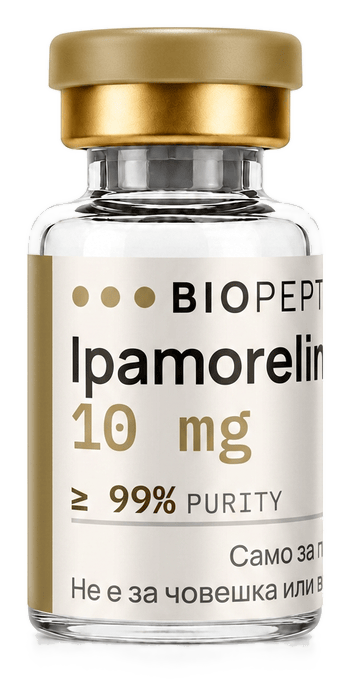
Ipamorelin
Selective growth-hormone secretagogue.
≥99% (HPLC)Size: 10 mg
Free delivery on orders over €70
Published
Important: This article is intended solely for educational and informational purposes. It does not constitute medical advice and does not encourage the injection, ingestion or any use of peptides in humans or animals. The products on this site are intended for scientific research and laboratory purposes only.
Ipamorelin is a synthetic peptide developed as a selective growth hormone secretagogue (GHS) — a molecule able to stimulate the release of growth hormone (GH). It belongs to the peptides acting through the ghrelin receptor (GHS-R), and is of particular interest because it was designed to stimulate GH secretion with less influence on other pituitary hormones than some earlier secretagogues. The literature shows a clear effect on GH release in preclinical models and early human studies; long-term clinical data are limited.
Ipamorelin is a synthetic pentapeptide developed as an analogue of the growth hormone secretagogues. Its defining feature is interaction with the growth hormone secretagogue receptor (GHS-R) — the receptor through which ghrelin and other secretagogues stimulate GH release. Activating GHS-R in the somatotroph cells of the pituitary triggers a signalling mechanism that releases stored growth hormone. Roughly: ipamorelin → GHS-R → pituitary → increased GH. That distinguishes it from direct administration of recombinant human growth hormone.
Growth hormone participates in growth and development, protein and lipid metabolism, regulation of body composition, tissue repair and the regulation of IGF-1. A large share of GH's effects run through insulin-like growth factor 1 (IGF-1), produced mainly in the liver but also locally in various tissues. Studies of GH secretagogues therefore track both GH and IGF-1 concentrations.
Ipamorelin binds GHS-R and stimulates GH release from the pituitary. One reason it drew attention is selectivity: some earlier GHS molecules also significantly affected other hormones, including ACTH and cortisol. In the original preclinical work, ipamorelin stimulated GH while, under comparable conditions, not provoking significant ACTH or cortisol release. This is one of the peptide's key pharmacological characteristics.
The first generations of growth hormone secretagogues include molecules such as GHRP-2 and GHRP-6. They can stimulate GH, but their effects are not limited to it — GHRP-2, for example, can influence ACTH and cortisol. Ipamorelin was developed to keep the GH stimulation while reducing those additional hormonal effects, and the experimental models support that concept. This does not make ipamorelin fully GH-specific, but its profile is more selective than some older secretagogues.
An early clinical study modelled the pharmacokinetics and pharmacodynamics of intravenous ipamorelin in healthy volunteers, observing a significant rise in plasma GH after administration. The pharmacokinetic data showed relatively brief exposure to the peptide itself, while the hormonal response unfolded as a separate physiological process. That is an important distinction: ipamorelin is not GH — it is a signal that prompts the body to release its own GH.
One of the few larger clinical programmes with ipamorelin was a randomised, placebo-controlled proof-of-concept study in patients with postoperative ileus after bowel resection. The investigators observed a pharmacodynamic response, but the study did not provide evidence that ipamorelin improves clinical outcomes in that population. It is an important illustration of the difference between “the peptide raises a hormone” and “raising that hormone improves a health outcome” — the two claims are not equivalent.
GH and IGF-1 form an interconnected endocrine system. After GH is released from the pituitary it reaches peripheral tissues and stimulates IGF-1 production, especially in the liver. Stimulating GH through GHS-R can therefore secondarily change IGF-1: ipamorelin → GHS-R → higher GH → higher IGF-1. The real physiology is more complex, since GH secretion is pulsatile and regulated by many factors.
Growth hormone is not released continuously. In healthy people it is secreted in pulses, with the largest peaks usually during sleep. This matters when interpreting secretagogue results: a single GH measurement can be hard to read because concentrations naturally vary widely. Studies therefore use serial measurements, integrated concentrations or other pharmacodynamic endpoints.
Because GH takes part in lipid metabolism, protein synthesis and sleep-linked secretion, secretagogues are used as tools to study those processes. A change in GH or IGF-1 is a pharmacodynamic marker; no adequate trials link ipamorelin to changes in body composition, muscle or sleep.
Clinical data on ipamorelin is far more limited than for approved medicines acting on the GH axis. Raised GH/IGF-1 activity can be associated with changes in glucose metabolism, fluid retention, soft tissue changes, joint discomfort and elevated IGF-1. This does not mean everyone exposed to ipamorelin will develop such effects — it means long-term safety has not been adequately characterised.
Ipamorelin is a synthetic growth hormone secretagogue developed to stimulate GH release selectively through GHS-R. Preclinical and early clinical research shows it can markedly stimulate GH secretion with less effect on ACTH and cortisol than some older GHRP molecules — which explains the scientific interest in it as a tool for studying the GH/IGF-1 axis. Effects beyond GH secretion have not been established in clinical studies. The most accurate description today: an experimental, selective stimulator of growth hormone secretion whose pharmacology is fairly well characterised, but whose long-term clinical benefits and safety in healthy people remain insufficiently studied.